


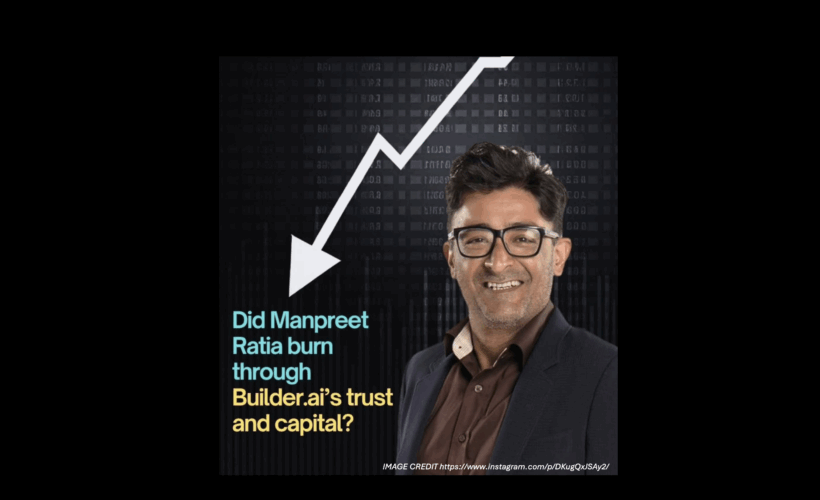
A recent news report in Businessworld about Builder AI is shocking and reveals the sad turn of events that brought downfall and reconstructs a troubling picture of how board observer Manpreet Ratia may have operated far beyond the remit of an observer.
The story quotes a law firm’s review of more than 13,000 WhatsApp messages, email trails, contracts, dashboards and trackers suggests that Ratia became deeply embedded in operational and financial functions at Builder.ai, a company once celebrated as a UK-based unicorn backed by investors such as Microsoft, Qatar Investment Authority, ICONIQ Capital and Insight Partners.
Builder.ai’s rapid rise, built on the promise of enabling complex app development without code, had made it one of the tech ecosystem’s standout stories. Its awards and global recognition amplified this perception. The company’s collapse, therefore, has intensified scrutiny over its internal governance, and the law firm’s findings place Ratia’s conduct at the centre of this examination.
Formally, Ratia was only a board observer representing Jungle Ventures. In practice, the document shows him participating in operational and financial conversations, particularly around Ver Se transactions. WhatsApp logs reviewed by the law firm indicate his involvement in editing responses to Ver Se that were meant for Deloitte’s audit queries, shaping how reseller commissions would be described, and advising on email framing relating to repayment schedules. In one instance, a message authored by him later appeared in an internal investigation mis-attributed to another individual, underscoring the depth of his participation.
Even though the report does not describe him as a “shadow CFO”, it notes that his actions blurred the line between oversight and management. Ratia appears in chats discussing reseller commissions linked to Ver Se, refining audit-related language, and being cited by former employees as part of audit committee awareness around reseller structures. According to the law firm, this pattern suggested that an investor representative was exerting operational influence without the documentation, clarity or accountability associated with a formal executive role.
The evidence catalogue also highlights how Builder.ai’s internal machinery operated heavily through WhatsApp instructions, Build Cards, dashboards and trackers. The Ver Se relationship alone involved approximately USD 83.6 million in software, licensing and cloud invoices raised by Builder.ai entities, and about USD 53.3 million in advertising invoices raised by Ver Se and Quark on Engineer.ai Corp, supported by contracts, campaign reports and screenshots of Dailyhunt ads. The law firm concludes that this work was real, that Ver Se was an independent counterparty, and that the JoshFan app was indeed built. The central issue, therefore, was not fictitious activity but unclear internal control over who was influencing decisions.
The dossier also documents Ratia’s interactions on personnel and finance. He approved external board positions for the Global Head of Finance, Gunjan Bhartia, saying “Should be ok. Just document it with us.” He was involved in onboarding processes such as adding Bhartia to email threads and requesting a Builder.ai email ID for him. The report further cites his participation in decisions like extending Brex payments, examining GST implications, and requesting invoice breakdowns on a USD 1.3 million payment flagged by Bhartia.
While not accusing Ratia of creating sham transactions or misappropriating funds, the law firm shows how an observer with significant informal sway could shape key financial and operational threads without being formally accountable. Combined with the dismantling of an earlier internal investigation that had advanced extreme allegations, the findings depict a governance vacuum where decisions of consequence were debated not in minuted forums but in unstructured chat groups.
In that environment, the law firm concludes, Builder.ai’s collapse was less about fabricated revenue and more about the opaque exercise of power—and the uncomfortable reality that an observer appeared to be steering, not watching.