


India’s metal producers have just reported one of their best quarters on record. Some of what drove those profits will stay. Some of it came from a war that may be heading towards an end.
India’s metal companies have rarely had a quarter like this one.
Hindalco and NALCO reported their best-ever results. Vedanta’s aluminium business earned an EBITDA margin of 46%, a level most manufacturers never see. Hindustan Zinc’s profit more than doubled.
The question for investors is not whether the quarter was good. It is how much of it can be repeated.
Durable?
Some of the drivers behind these profits are durable.
Domestic demand. India’s spending on roads, railways, housing, power transmission and vehicles has kept demand for steel, aluminium and copper strong, and that spending is planned years in advance. Tata Steel’s Indian deliveries rose 16% from the June quarter, even though the monsoon usually slows construction. Record car sales this festive season point the same way.
Low costs. Indian producers are among the cheapest in the world. Most run smelters on captive coal-based power and mine much of their own raw material. That advantage does not depend on the war.
Diversification. Hindalco now earns almost half its profit from businesses whose earnings are not directly tied to the price of aluminium: its US subsidiary Novelis, copper and downstream products. Its copper business had its best quarter ever, helped by demand from power grids, electric vehicles and data centres. Those are long-term trends.
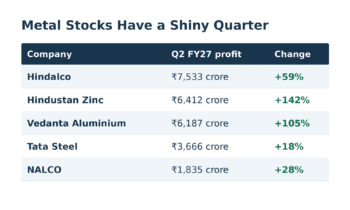
Will the shine fade?
Other drivers are temporary.
The war premium. Smelting aluminium uses enormous amounts of electricity. When the Iran war pushed up oil and gas prices, smelters in Europe and parts of Asia that depend on gas-fired power faced soaring costs, and some cut output. That kept global aluminium prices high, while Indian producers on coal-based power enjoyed the higher prices without the cost spike.
That advantage is directly tied to the conflict. Last week, Brent crude fell 16% on hopes of a US-Iran settlement. A deal that reopens the Strait of Hormuz would bring energy prices down further, let overseas smelters restart, and likely push aluminium prices lower. The extraordinary margins of the past two quarters would shrink.
One-off gains. Some of this quarter’s numbers include items that won’t recur. Novelis’s results, for instance, included insurance recoveries related to last year’s fire at its Oswego plant.
Factors to watch
Two other risks sit outside the companies’ control.
China. Chinese exports rose 36% in September. When China’s domestic demand is weak, its steelmakers and smelters export more, often at low prices. Cheap Chinese metal flowing into Asia can push down prices for Indian producers, who have relied on trade protections to limit imports.
Debt. Several producers are borrowing to expand. Hindalco’s net debt has risen to 1.8 times its annual operating profit, from 1.23 times a year ago, partly to fund a new US rolling mill. Tata Steel’s net debt stands at ₹91,423 crore. High borrowing is easy to carry when metal prices are high, and much harder when they fall.
Demand from India’s infrastructure build-out, low production costs and the shift towards copper and value-added products should keep these companies profitable for years. But the exceptional margins of this quarter owe a great deal to a war that may be heading towards a settlement.
For investors, the most useful step is to separate the two. Profits built on Indian demand and low costs are likely to hold, while the gains built on the war’s energy shock are not. The progress of US-Iran talks may now matter as much to India’s metal companies
About The Author