The big brands rallied on Dhanteras while several smaller jewellers slipped. Every listed jeweller is reporting 20–30% growth, but much of it comes from the gold price rather than from more jewellery leaving the shops.
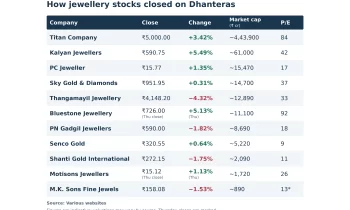
India’s two largest listed jewellers had a strong Dhanteras on the stock market. Kalyan Jewellers closed 5.49% higher at ₹590.75 on Friday, and Titan rose 3.42% to ₹5,000, ending the day about 3.6% below its 52-week high of ₹5,186.70.
Titan’s session was more volatile than its close suggests. The stock fell as low as ₹4,694.40 in early trade before buyers stepped in, and it closed near the day’s high of ₹5,013.90. Kalyan traded between ₹552.30 and ₹598.30.
The smaller names did not share in the rally. Thangamayil Jewellery fell 4.32% to ₹4,148.20, PN Gadgil slipped 1.82% and Shanti Gold lost 1.75%. M.K. Sons Fine Jewels, which listed on Wednesday at a 5.6% premium to its IPO price of ₹162, closed at ₹158.08, below its issue price for the first time and at its lowest level since listing.
The split came on a day when the Sensex rose 2.17%, led by large companies, and gold futures fell about ₹2,000 per 10 grams on the MCX in early trade.
Thangamayil’s fall extends a difficult week. The stock dropped 5.8% on Wednesday and now stands about 44% below its 52-week high of ₹7,430. Shanti Gold has also struggled: it fell as much as 14% on Wednesday morning, and Friday’s close left it more than 8% below Tuesday’s level. PC Jeweller remained one of the most heavily traded stocks on the NSE, as it has been all week.
Foreign investors have been buying the sector. Foreign institutions raised their stakes in several jewellery companies during the September quarter. Their holding in PN Gadgil rose to 3.83% from 0.48%, in Kalyan to 13.83% from 10.82%, and in Titan to 16.37% from 15.39%. Smaller increases were recorded in Shanti Gold and Thangamayil.
Titan’s results, released the evening before Dhanteras. Consolidated net profit more than doubled to ₹2,393 crore, including a one-time gain of ₹671 crore from revaluing a financial liability. Excluding that, profit rose 54% to ₹1,722 crore, about 17% above the LSEG consensus.
PN Gadgil’s net profit rose 52.7% to ₹121.11 crore. Kalyan has published only a business update so far and will report full results later this month. Senco said its first-half revenue crossed ₹5,000 crore for the first time, up 48%.
All of this came despite the Navratri festival moving into the December quarter this year, which made the September-quarter comparison harder.
What’s really growing
Gold prices were about 28% higher than a year earlier during the September quarter, according to Senco Gold’s business update.
A jeweller’s revenue is largely the value of the gold it sells. If gold is 28% more expensive and a jeweller sells the same weight of jewellery, its revenue rises about 28%. Same-store sales growth of 19% to 25%, below or close to the rise in gold prices, suggests the weight of gold sold through existing stores was roughly flat or slightly lower.
In other words, Indian households are spending more on jewellery, but they are not buying much more of it.
Senco’s update supports that reading. More than half its sales now involve customers trading in old gold, meaning many buyers are exchanging existing jewellery rather than buying fresh metal. Diamond jewellery revenue grew 31% in value, but volumes grew only 7%. The traders’ body CAIT pointed to the same trend on Dhanteras itself, reporting strong demand for lightweight 14-carat and 18-carat pieces.
That does not make the growth illusory. Three real shifts are under way. Listed chains are taking share from small family jewellers, a trend that high gold prices accelerate because customers buying expensive pieces want hallmarking, transparent pricing and buy-back policies.
Studded jewellery, which uses less gold and earns higher margins, is growing faster than plain gold: Titan’s studded sales grew at a rate in the early thirties, and Senco’s stud ratio rose to 12.2%. And store networks are expanding quickly. Kalyan now has 546 stores and Senco 215, and Kalyan’s digital-first brand Candere grew revenue about 64%.
A gap in valuations
The table shows something striking: companies reporting broadly similar growth trade at very different valuations.
At the bottom, Senco trades near 9 times trailing earnings, and Shanti Gold and M.K. Sons around 11 to 13. PC Jeweller sits near 17 and PN Gadgil near 18. Kalyan trades around 42. At the top, Titan trades at about 84 times trailing earnings and Bluestone, the newest listed retailer, at about 92. The most expensive stocks in the sector are valued at roughly 10 times the cheapest.
Friday’s trading pushed that gap wider. The two most richly valued large names, Titan and Kalyan, gained the most, while several of the cheaper regional players fell.
Part of the gap reflects real differences. Titan has decades of brand strength, a large studded jewellery business and steady margins. Kalyan has a national network and a presence in the Middle East. Bluestone is valued as a fast-growing, design-led brand rather than a traditional jeweller. Smaller regional players depend on a few states, have less pricing power, and some carry more risk from unhedged gold exposure. Shanti Gold and Sky Gold are also largely manufacturers and wholesalers rather than retailers, and the market generally values manufacturing at lower multiples.
But the gap also reflects where the money is coming from. Foreign investors, who bought heavily this week, concentrate on large, liquid stocks, and Friday’s market rally was led almost entirely by big companies while small caps fell. If the regional jewellers can keep growing at 25–30% while expanding beyond their home states, the valuation gap could narrow. If gold stays volatile and squeezes margins, investors are likely to keep favouring the larger names.
The risks
The biggest risk remains gold itself. Prices rose about 5% in the four sessions to Thursday, then fell about ₹2,000 per 10 grams on Friday morning. Very high prices discourage first-time buyers and push existing customers towards exchange schemes, which support revenue but weigh on margins. Senco has already flagged margin pressure from old-gold exchanges.
The December quarter will be the real test. With Navratri, Dhanteras and Diwali all falling in that period this year, the next round of results will show whether India’s jewellers can keep growing when the comparison is against a full festive season.
About The Author