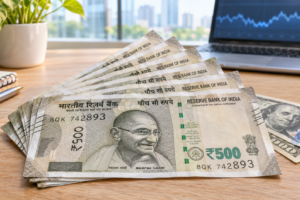
The festival’s rupee numbers look almost identical to last year’s. What households carried home in those little red boxes, though, was lighter.
Dhanteras has its own rhythm in an Indian jewellery shop. The mornings begin with families who have been planning for weeks, the old gold carefully wrapped in a handkerchief for exchange, the budget agreed at home over dinner the night before. By evening the counters are crowded with people who simply could not let the day pass without buying something, however small, because a festival meant for welcoming prosperity feels incomplete without a little gold.
This year, that ritual met a price it had to bargain with.
Jewellers across the country reported strong demand for lightweight pieces in 14-carat and 18-carat gold, according to the Confederation of All India Traders, alongside brisk sales of silver coins and decorative items. The heavy 22-carat necklace, the kind traditionally bought for a daughter’s future, remained on many wish lists, but fewer made it to the billing counter.
The traders’ body had forecast that Dhanteras would generate more than ₹1 lakh crore of business across India, with gold and silver accounting for over ₹60,000 crore. Those numbers carry a curious echo. A year ago, for Dhanteras 2025, CAIT’s estimates were almost exactly the same: festive trade above ₹1 lakh crore, gold and silver around ₹60,000 crore.
In the meantime, gold has become considerably dearer. By CAIT’s reckoning it is still about 20% above last year’s level; on the Mumbai reference rate, 24-carat gold is up about 9% since the last Dhanteras. Whichever measure one chooses, the arithmetic points the same way. If households spent a similar sum in rupees, they brought home fewer grams.
The move towards lower-carat gold is the quiet engine of that change. An 18-carat piece contains 75% gold and a 14-carat piece about 58%, against roughly 92% in traditional 22-carat jewellery. A family can choose a design that looks every bit as festive for a noticeably smaller bill. Jewellers, for their part, are not complaining. When less metal goes into each piece, craftsmanship and design account for a bigger share of the price, and those tend to be the more profitable parts of the business.
The listed jewellers have watched this shift build for months. Senco Gold reported that its diamond jewellery sales rose 31% in value but only 7% in volume in the September quarter, and that more than half of its sales now involve customers trading in old gold, often a grandmother’s bangle reborn as something lighter and more modern.
Buyers did catch a small break on the day itself. Gold futures on the MCX dropped about ₹2,000 per 10 grams on Friday morning as global markets slid, and CAIT quoted 24-carat gold at ₹1,41,840 per 10 grams at the time of its estimate, below the roughly ₹1.46 lakh seen a day earlier. It came after the metal had risen about 5% in the four sessions leading up to the festival, which may have persuaded some hesitant buyers to finally step in.
The final tally will take time. CAIT’s figures are projections and count rupees rather than grams, and the All India Jewellers and Goldsmith Federation said it would publish its own reading of actual sales. Import data and jewellers’ December-quarter results, which this year will capture Navratri, Dhanteras and Diwali together, will tell the fuller story.
CAIT expects more than ₹7 lakh crore of festive spending between Navratri and Diwali, up 15–18% on last year. Gold remains at the heart of that spending. The pieces are simply getting a little lighter.
About The Author