

In six weeks, Nvidia has lost about $1.9 trillion of market value and its place at the top of the world’s stock markets. But look closely at where that money went, and you can see investors haven’t given up on AI.
There’s a number that explains this month’s upheaval at the top of global markets better than any headline.
Since early October, Nvidia’s market value has fallen from about $5.8 trillion to about $3.9 trillion. That’s roughly $1.9 trillion gone in six weeks, more than the entire value of Broadcom, Saudi Aramco or Meta. To put the scale in Indian terms, the world’s ten most valuable companies are now worth about $28.6 trillion between them, more than five times the value of India’s entire stock market.
Yet the AI trade has not completely disappeared or collapsed. Other AI-linked companies have held up, and some have risen. When a company sheds that much value and its industry doesn’t follow, it’s worth asking where the money went, and why.
Let’s start with the obvious: Nvidia was hit by two blows in quick succession. A post-election sell-off in AI stocks arrived in early November. Then a scandal forced founder Jensen Huang to resign as chief executive on 12 November, after 33 years. Its shares are now down for 2026, the worst performance among the top 10 this year, and it briefly lost second place to Microsoft on 10 November
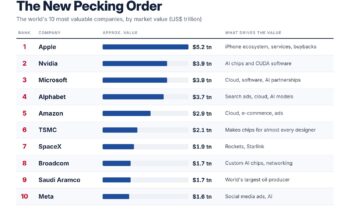
Other important companies in the pecking order that have gained.
TSMC manufactures chips for Nvidia, Apple, AMD and nearly every other major designer. It has been one of the top 10’s biggest winners this year.
Broadcom, which designs custom AI chips for cloud giants that want alternatives to Nvidia, rose about 18% in a single week.
Apple, whose income depends far less on the AI arms race, reclaimed the top spot.
In other words, investors pulled money from the single company most exposed to one person and one product line, and moved it to businesses that profit from AI whichever chip designer wins.
A change
For two years, Nvidia was treated as the AI trade itself. It designed the chips, owned the software platform developers relied on, and captured an outsized share of the profits from the AI build-out. That concentration made it extraordinarily valuable, and extraordinarily exposed.
The reshuffle suggests investors are now paying a premium for something different: being essential to everyone, rather than dominant over one segment.
In addition, the trillion-dollar club is younger than it looks. Apple became the first US company worth $1 trillion in August 2018. Nvidia crossed that mark in May 2023, the first chipmaker to do so, then raced through each trillion faster than any company before it, passing $5 trillion in late 2025.
Apple has grown about fivefold since its first trillion, in roughly eight years, built largely on turning a hardware business into a services machine: music, video, storage, payments and app store fees, plus hundreds of billions of dollars spent buying back its own shares.
The composition of the club has changed even more. In the early 2010s, the world’s most valuable companies included ExxonMobil, General Electric and AT&T. Today, eight of the top 10 are technology companies or closely tied to computing and AI. Only Saudi Aramco represents the old economy.
The newest member arrived this year. SpaceX listed on Nasdaq in June and is now worth about $1.9 trillion. If its reported merger talks with Tesla produce a deal, as soon as December according to Bloomberg, the combined company would be worth about $3.5 trillion, close to the top three.
What the market is paying for
The concentration at the top is unprecedented. The top 10 now make up about a fifth of the value of every listed company in the world (using an estimated $150 trillion total). That brings three risks.
Concentration risk for ordinary investors. Anyone who owns a US index fund has a large share of their money in these few names. When one stumbles, as Nvidia did, the whole index feels it.
Key-person risk. Nvidia’s fall shows how much value can depend on a single leader. Several companies in the top 10 remain closely identified with founders or long-serving chief executives.
Valuation risk. Many of these companies are priced for years of strong growth. If AI spending slows, or interest rates keep rising as the US Federal Reserve now signals, high valuations leave little room for disappointment.
What to watch
Three events over the coming weeks could reshuffle the order again.
Nvidia’s results on 17 November, its first report without Huang. Strong demand for its chips could stabilise the stock. Weak numbers could push it further down the table.
The SpaceX-Tesla talks. A merger would create a new heavyweight near the top.
US interest rates. The Fed meets on 8 and 9 December. Higher rates tend to weigh hardest on the most richly valued companies.
Apple alone, at about $5.2 trillion, is worth nearly as much as every company on the BSE combined, about ₹511 lakh crore or roughly $5.45 trillion (our calculation). No Indian company comes close to the trillion-dollar mark.
But India is gaining ground in global portfolios. MSCI raised India’s weight in its emerging markets index this week, and foreign investors have bought more than ₹80,000 crore of Indian shares in November, partly as they moved money away from AI-heavy US stocks.
For Indians who own US stocks through international funds or overseas accounts, the reshuffle may have a lesson: the biggest companies in the world are not the same as the safest ones. And when the leader falls, the winners are often the businesses that quietly supply everyone else.
About The Author