

US markets swung from their best post-election rally in decades to their worst day since April 2025 within 24 hours. By Friday, the Democrats’ sweep had rearranged winners and losers rather than simply lifting or sinking stocks.
When Democrats swept both houses of Congress on Tuesday, handing the Republican Party its first loss of both chambers under a sitting president in about 20 years, Wall Street’s first reaction was relief.
It lasted exactly one day.
Wednesday: the relief rally
On Wednesday, the Dow Jones Industrial Average jumped 1,569 points, or 3.03%, to 53,356.12. It was the Dow’s best day since April 2025 and its biggest gain after a midterm election since 1982. The S&P 500 rose 1.58%, its best day in three months, and the Nasdaq gained 1.44%.
Investors liked three things about the result. Divided government usually means fewer sweeping policy changes, which reduces uncertainty for businesses. The White House’s own reading of the defeat, which linked it to the unpopularity of the Iran war, raised hopes of a faster settlement. And that sent oil prices tumbling: Brent fell almost 9% on the day.
The gains were broad, led by companies tied to the everyday economy. Consumer discretionary stocks rose 4.3%. Walmart, Bank of America, Microsoft, Amazon and Apple all rallied, and Apple closed at a record.
But there was an early warning. Nvidia fell 3% and CoreWeave about 10%. Investors were already wondering what a Democratic Congress would mean for artificial intelligence.
Thursday: the AI reckoning
On Thursday, that question took over.
The Nasdaq Composite plunged 5.52% to 24,315, its worst day since April 2025, closing more than 10% below its October record and entering correction territory. The S&P 500 fell 4.36%. The Dow lost 1,833 points, wiping out all of Wednesday’s gain. Every one of the S&P 500’s 11 sectors fell, and losers outnumbered winners on the New York Stock Exchange by about seven to one.
Chipmakers led the rout. Nvidia sank about 9.3%, and the Philadelphia Semiconductor Index plunged more than 12%. Wall Street’s fear gauge, the VIX, jumped about 70% to its highest level since March.
The trigger was the realisation of what a Democratic Congress could mean for AI: tighter rules on how the technology is developed and used, scrutiny of the energy demands of data centres, and pressure on the hundreds of billions of dollars technology companies are spending on AI infrastructure. For chipmakers and data-centre operators, who depend on that spending, the threat was direct.
President Trump blamed Democrats for the sell-off
Friday: a partial rebound
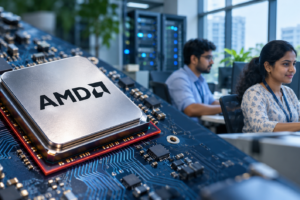
Friday brought a measure of calm. The Nasdaq recovered 1.09% to 24,579.42 as chip stocks bounced, with AMD jumping 10.8% and Nvidia gaining 3.9%. The S&P 500 edged up 0.31% to 7,376.86, while the Dow slipped 0.46% to 51,285.73. The VIX eased to about 25.5.
A much stronger-than-expected jobs report added a new complication. US employers added 165,000 jobs in October against forecasts of 65,000, raising the chance of a Federal Reserve rate increase in December to about 78%, according to market pricing reported by Bloomberg
For the week, the S&P 500 lost 2.7% and the Nasdaq 3.4%. All three major indexes posted their fourth straight weekly decline.
What the week actually changed
Look past the daily swings and the election’s real effect becomes clearer: it rearranged leadership in the market rather than simply pushing it up or down.
The winners were companies tied to the broader economy, which benefit from lower oil prices, a calmer geopolitical outlook and policy stability. The losers were the AI infrastructure stocks that had led US markets for three years, which now face political and regulatory risk that was barely priced in a week ago.
Crypto was caught in the middle. Bitcoin briefly fell to a six-week low as results came in, since a Democratic Congress is seen as less friendly to crypto-related legislation, before recovering above $80,000 along with the broader market.
Why it matters for India
The rotation away from AI did not stay in America. Global funds that had piled into AI-heavy markets such as South Korea, Taiwan and Japan cut exposure, and some of that money came to India, which has almost no AI hardware companies. Foreign investors bought ₹38,971 crore of Indian shares last week, according to NSDL data, helping lift the Nifty 7.6%.
If AI stocks stabilise and US markets recover, the rush of foreign money into India could slow. And if the Fed raises rates in December, higher US yields would make dollar assets more attractive again.
The US midterm result has given Indian markets a lift. How long it lasts may depend as much on Washington and the Fed as on anything happening in India.
About The Author