Swiggy’s loss narrowed from a year ago and its food delivery business had its most profitable quarter yet. But losses at Instamart, its quick-commerce arm, rose again, and the stock fell to a record low.
Swiggy’s September-quarter results show its two businesses on different spectrums.
While the headline number looked better, the consolidated net loss narrowed 15.6% to ₹922 crore from ₹1,092 crore, and revenue from operations rose 36% to ₹7,571 crore.
Investors focused on the sequential picture instead: the loss widened by about 17% from ₹791 crore in the June quarter, because spending on Instamart and new ventures grew faster than revenue. Total expenses rose to ₹8,703 crore from ₹6,711 crore a year ago.
The shares fell more than 13% on Friday trading at ₹180, a record low and about 54% below the IPO price of ₹390.
Food delivery is now picking up. Its adjusted EBITDA rose by ₹101 crore from a year earlier to a record ₹341 crore, and revenue grew about 22% to ₹2,338 crore. Swiggy can now rely on the business that made it a household name to generate steady profits.
Instamart is in a capital quagmire. Its adjusted EBITDA loss rose to ₹895 crore from ₹778 crore in the June quarter. Gross order value grew 31.4% from a year earlier to ₹9,230 crore, and net order value rose 31.4% to ₹6,594 crore.
Swiggy added 69 dark stores, taking the network to 1,240. But its contribution margin, which measures whether each order covers its direct costs before overheads, fell back to minus 1% of order value. That was 157 basis points better than last year but 82 basis points worse than in the June quarter.
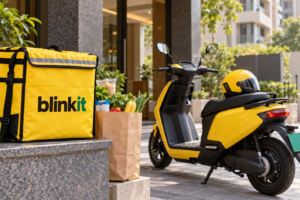
The comparison with Eternal, reported a day earlier, explains much of the market’s reaction. Eternal’s Blinkit made an adjusted operating profit of ₹184 crore in the same quarter and recorded net order value of ₹20,940 crore, roughly three times Instamart’s.
Blinkit is also growing faster, at 79% a year against Instamart’s 31%. In quick commerce, scale matters a lot: dark stores that handle more orders spread their rent, staff and delivery costs more thinly, which is how they turn profitable. Blinkit has passed that point and Instamart has not. As Instamart falls further behind, catching up will cost more.
Swiggy’s plan to close the gap is to change how Instamart operates. Domestic shareholders now own more than 58% of the company, which means Instamart can hold its own inventory, the same move that helped Blinkit improve its margins. Owning inventory lets a quick-commerce company buy directly, control its range and earn better margins than it does on commissions alone. The cost is more working capital and more risk tied up in unsold stock.
Swiggy is also spending on new ventures, including Toing, a budget food delivery app. Each one adds to losses in the short term. For a company whose shares are at a record low, that is a hard case to make to investors.
Over the first half of the year, Swiggy’s net loss fell about 25% to ₹1,713 crore on revenue of ₹14,383 crore. The trend is improving over a longer period. The problem is that improvement in food delivery is being offset by losses in quick commerce, and the market now values Swiggy at about ₹58,353 crore, a fraction of Eternal’s valuation.
The question for investors is whether Instamart can reach the scale to become profitable before its losses outweigh the profits from food delivery. Moving to an inventory model is Swiggy’s best chance of changing the numbers, and the next two quarters will show whether it works.
About The Author