What began as a sell-off in AI stocks became one of the worst weeks for global markets in years, spreading to precious metals, industrial metals, crude, crypto and shares around the world. Indian shares were among the very few to rise.
It was the kind of week traders talk about for years.
It started with AI stocks and spread almost everywhere. By Friday night, investors had sold almost everything. Silver lost a sixth of its value in five days. Gold, the asset investors normally buy when markets panic, fell almost 9%. Crude oil fell for a third straight week, taking its November fall to about 23%.
Bitcoin dropped below $58,000, about ₹54 lakh, its lowest in more than two years and less than half its peak. Copper and tin fell sharply.
On Wall Street, the Nasdaq lost 10% in a week and wiped out all its gains for the year, while the S&P 500 and the Dow both fell into correction. In Taipei, the stock market had its worst week since 1991.
Even assets normally seen as safe gave no protection. Investors sold gold, silver, Bitcoin and shares together.
In Mumbai, the market went up. The Sensex rose 2.85% to 83,919.71 and the Nifty 2.61% to 25,800.60. Both closed at nine-month highs and gained for a fourth straight week. In a week when the Nasdaq fell 10%, Indian shares rose almost 3%.
The gap between the two markets was nearly 13 percentage points, which is very rare for two major stock markets in a single week.
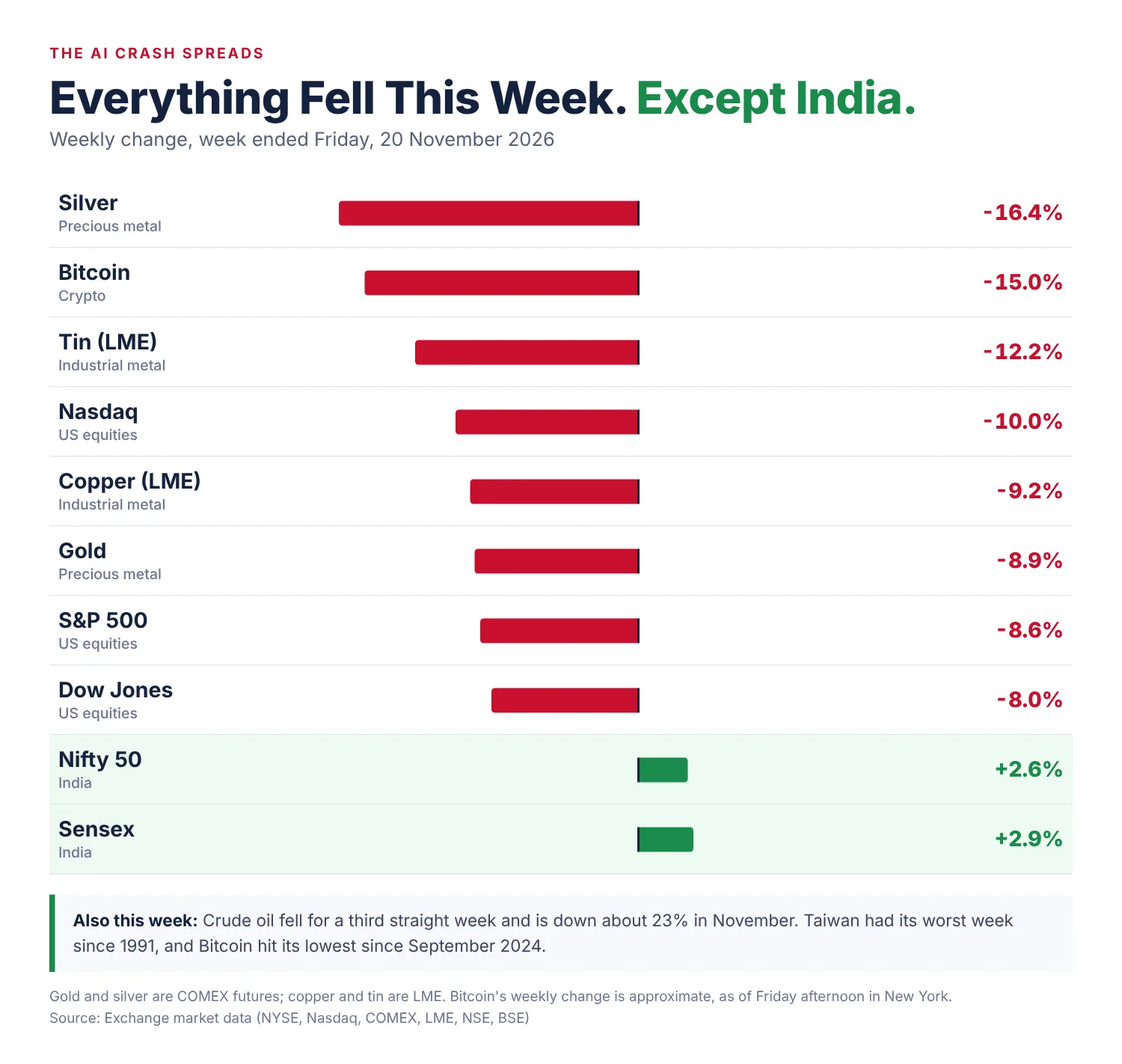
How the AI crash spread
When assets that usually move in different directions all fall at once, it is usually because investors are under pressure to sell, not because each asset has been reassessed. Last week’s sell-off happened in three stages.
The first was AI stocks. Over six weeks, investors have grown more doubtful that the hundreds of billions of dollars being spent on AI data centres will pay off.
Last week, those doubts turned into heavy selling. Nvidia lost its chief executive earlier this month, and on Friday its shares fell 14% after reports that the SEC was reviewing its accounting. That fall wiped out about $491 billion, or roughly ₹45.7 lakh crore, of market value in one day.
Anthropic, the year’s most anticipated IPO, gave back most of its first-day gain within 24 hours. Chipmakers in Seoul, Taipei and Tokyo fell with Nvidia.
The second was interest rates. Futures markets now see a December rate hike by the US Federal Reserve as almost certain, after Fed officials said rates are not yet high enough to bring inflation down. Higher rates increase the cost of borrowing to invest and make safe US bonds more attractive than assets that pay no interest, such as gold, silver and Bitcoin.
The third was forced selling. Funds hit by losses on tech stocks had to raise cash quickly, and they sold the assets that were easiest to sell and had risen the most: gold, silver and Bitcoin.
In Kitco’s view, this is a squeeze on dollar funding in which gold is sold first, because it is the easiest asset to turn into cash. Industrial commodities also fell for a reason of their own.
If AI data-centre construction slows, so does demand for the copper, power and fuel those data centres need. Copper on the London Metal Exchange has fallen for six weeks in a row, and crude for three, as investors price in slower global growth.
Why India held
India had three things working in its favour, and the first was what it doesn’t have. India’s stock market has almost no chipmakers, no AI hardware suppliers and few companies whose value depends on AI spending.
As global investors sold AI stocks, many looked for large markets that would not be hit by the same sell-off, and India was one of the biggest. Foreign investors put a record ₹1.15 lakh crore, about $12.2 billion, into Indian shares in November, the most for any month on record, with more than a week of the month still to go.
The second was the fall in commodity prices, which hurt most markets but helped India. India imports most of the oil it uses, and gold is one of its largest imports after crude. Both fell sharply at the same time.
Cheaper oil and gold reduce India’s import bill, narrow its trade deficit and support the rupee, which strengthened to a seven-month high during the week. They also lower costs for companies that use fuel and raw materials. Few other large markets got that kind of support from the same sell-off.
The third was company results. Indian companies reported strong September-quarter results, led by banks, and banks also led the market’s rise.
ICICI Bank and Axis Bank both hit all-time highs on Friday. That matters because it means at least part of India’s rise reflects improving profits rather than only money flowing in.
But two of those three advantages depend on foreign investors and commodity prices, and either could change quickly.
The scale of the money involved shows the risk. Nvidia lost about 40 times as much value on Friday as foreign investors have put into Indian shares in the whole of November. India’s record inflow is very small compared with the amount of money moving around global markets.
That’s why it pushed Indian stocks up so effectively, and why it could reverse just as quickly. In past global sell-offs, foreign funds often sold the markets that were easy to sell and had done well, and India is now both.
A Fed rate hike would add to the pressure. A stronger dollar and higher returns on US bonds usually draw money away from emerging markets, and India’s recent rise relied more on foreign buying than usual.
Commodity prices are the other risk. Cheaper crude and gold have helped India because they fell.
If the sell-off ends and commodity prices recover, or if supply problems push oil prices up, that support would disappear.
India gained because the sell-off was about AI stocks and commodities, two areas where it has little exposure or actually benefits from falling prices. A sell-off driven by a strong dollar or a sudden global need for cash would test India in a different way.
India showed last week that it could stand apart from an AI sell-off, and that it can do the same if tested again.
About The Author