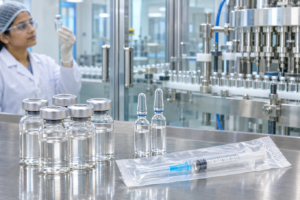


Laurus Labs used to be the company that made cheap HIV drugs for the developing world. Its latest results show a very different business: one that makes complex medicines for global drug companies and keeps a far bigger share of each rupee it earns. Here is what changed, and what has to go right from here.
When a company’s revenue grows by a third and its profit more than doubles, it’s worth slowing down and asking how. The answer usually says more about the business than the headline numbers do.
Laurus Labs is a good example. The Hyderabad drugmaker reported its September-quarter results on 29 October, and the stock has stayed in demand since, rallying again this week as contract manufacturers led the Nifty Pharma index to a record. To understand why investors keep coming back, you have to look past the 126% profit jump to what sits underneath it.
First, the headline figures. Consolidated net profit rose 126% to ₹441 crore, from ₹195 crore a year earlier. Revenue grew 33% to ₹2,206 crore, from ₹1,653 crore. EBITDA rose 78% to ₹762 crore, and the EBITDA margin widened to 34.5%. Gross margin improved to 63%. Profit before tax more than doubled to ₹592 crore from ₹270 crore.
The quarter also improved on the one before. Revenue rose about 9% from ₹2,026 crore in the June quarter, and profit about 20% from ₹368 crore.
For the first half of the year, revenue rose 31% to ₹4,233 crore, EBITDA rose 72% to ₹1,406 crore, and profit rose 126% to ₹809 crore. The half-year EBITDA margin widened by 7.8 percentage points to 33.2%.
Now the growth factor. A year ago, Laurus earned EBITDA of ₹429 crore on revenue of ₹1,653 crore. This quarter, it earned ₹762 crore on ₹2,206 crore. So for the extra ₹553 crore of revenue it brought in, it added about ₹333 crore of operating profit. In plain terms, Laurus kept roughly 60 paise of every additional rupee it earned (our calculation).
That is signature operating leverage. Laurus’s plants, scientists and overheads are largely fixed costs. Once those are covered, each additional order adds disproportionately to profit. It also suggests the new revenue is coming from higher-value work, which brings us to the real story.
Laurus shifts its focus
For most of its history, Laurus was known for one thing: low-cost generic medicines, especially antiretroviral drugs for HIV, sold in huge volumes to developing countries and global health programmes.
It was a respectable business, but a tough one. Margins were thin, competition was fierce, and revenue depended on winning large tenders.
The growth now comes from somewhere else. Laurus’s contract development and manufacturing business, known as CDMO, makes drug ingredients and complex molecules for global pharmaceutical companies under long-term agreements. Its revenue jumped 75% to ₹904 crore in the quarter, from ₹518 crore a year earlier.
That shift changes the shape of the company. A year ago, CDMO made up about 31% of revenue. This quarter, it made up about 41% (our calculation). The rest of the business, mainly generics, still grew, by roughly 15% on our numbers, but it is no longer the engine.
Why does this matter so much? Because the two businesses have very different economics.
In generics, you compete mostly on price, and any rival who can make the same molecule can undercut you.
In contract manufacturing, a global drug company chooses you to produce part of a medicine it has spent years and billions developing.
Once your plant is approved by regulators for that molecule, switching suppliers is slow, expensive and risky for the client. Contracts tend to last years, prices are better, and relationships are sticky.
As CDMO’s share of revenue rises, the whole company’s margins rise with it. That is exactly the pattern in these results.
The timing of this business too is good. Global drugmakers in the US and Europe are actively reducing their dependence on Chinese suppliers, and India, with its chemistry talent, regulatory track record and cost advantages, is the obvious alternative.
A wave of new medicines, including obesity and diabetes treatments, also requires complex chemistry that only a few manufacturers can deliver at scale. Laurus is well placed on both trends.
The company is also positioning for what comes next. It approved the purchase of a 60% stake in Galenvs Sciences, a Canadian company working on oligonucleotides, a class of drugs that act on genetic material and form one of the fastest-growing areas in medicine.
The deal is small, $3.75 million including $2.75 million of fresh capital, but the strategic logic is clear. The most valuable CDMO contracts of the next decade will go to manufacturers that can handle newer, harder drug types.
The board also declared an interim dividend of ₹1 per share, a small but welcome signal of confidence in cash generation.
But what could go wrong
While the stock rose about 5% to ₹2,354.90 the day after results, its been trending higher since last year, and has risen roughly two and a half times in a year. Its inclusion in the MSCI India index in August also brought in buying from global index funds.
That rally raises the bar. Laurus is no longer priced as a generics company. It is priced as a high-growth contract manufacturer, which means investors are assuming the CDMO business keeps growing quickly for years. A few things could get in the way.
Client concentration. CDMO revenue tends to depend on a handful of large clients and specific molecules. If a key client’s drug disappoints in the market, or a late-stage trial fails, the orders can shrink quickly.
Lumpiness. Contract manufacturing revenue doesn’t always grow in a straight line. A strong quarter can be followed by a flat one as projects move between phases. Investors used to steady growth may be surprised.
The generics drag. The legacy business still matters, and it remains exposed to price pressure and the timing of large tenders.
Currency. Laurus earns largely in dollars. The rupee has strengthened more than 3% in the past month, which trims the rupee value of those earnings, though a stronger dollar after this week’s hot US inflation data may ease that pressure.
For anyone following the stock, watch the signals. Watch whether CDMO revenue keeps growing quarter on quarter, not just year on year. Watch whether the EBITDA margin holds above 30% as new capacity comes on stream. And watch for evidence that early bets such as Galenvs turn into real client work.
If those boxes keep getting ticked, Laurus’s transformation from a tender-driven generics maker into a trusted manufacturing partner for global pharma will look less like a good year and more like a new identity. That, ultimately, is what the market is paying for.
About The Author