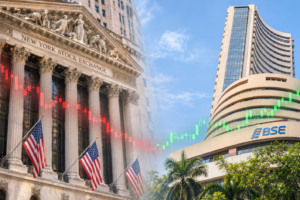
Indian shares opened lower after an overnight US tech crash, then turned higher within an hour. The recovery says something useful about who is driving this market.
ndian shares opened lower after a 5.5% crash in the Nasdaq, then turned higher within the first hour. The recovery shows how far the Indian market has moved away from US technology stocks.
The Sensex was up 567.64 points, or 0.72%, at 79,877.65 at 10:12 AM on Friday. The Nifty 50 gained 111.90 points, or 0.46%, to 24,648.50, back above 24,600.
That was not how the morning started. GIFT Nifty futures had pointed to a loss of more than 120 points before the open, and the Sensex fell about 188 points to 79,122 in early trade, with the Nifty dropping as low as 24,419. Within an hour, both had turned positive.
If the gains hold until the close, it will be a seventh straight day of gains, on a day when most major markets were falling.
The shock India absorbed
The overnight backdrop was severe. The Nasdaq Composite crashed 5.52% on Thursday, closing more than 10% below its October record and entering correction territory. The S&P 500 fell 4.36%, its worst day since April 2025, and the Dow lost 1,833 points, wiping out all of Wednesday’s post-election gain. Nvidia fell about 9%, and the main US semiconductor index dropped more than 12%. Japan’s Nikkei slid into a bear market.
The selling was driven by concern that a Democratic Congress will tighten rules on AI and slow the heavy spending on data centres that has powered the US technology rally.
India has little direct exposure to that trade. There is no Indian equivalent of Nvidia in the Nifty. The index is dominated by banks, financial services, carmakers, consumer goods companies and energy, none of which are directly affected by AI regulation in Washington. Indian IT companies are the exception, since they depend on US technology spending, but they now make up a much smaller part of the index than banks and financial stocks.
Results-driven buying added support. Stocks that reported on Thursday attracted strong demand, according to Business Standard’s live coverage. M&M was up about 5%, adding to Thursday’s 6.5% rally after its September-quarter profit beat expectations.
Foreign money also matters. Foreign investors bought more than ₹14,000 crore of Indian shares on Tuesday and Wednesday combined, after selling heavily for most of the year. Funds rebuilding positions in India do not usually reverse course after one bad session in New York.
What could still go wrong
The biggest risk this morning is not Wall Street. It is oil.
This week’s rally was built mainly on falling crude. Brent dropped from near $118 last Friday to $94.62 on Wednesday, as the US midterm results raised expectations of an end to the Iran war. Since then, it has climbed back close to $100, according to Business Standard. Eurasia Group, a political risk consultancy, has halved its estimate of the chance of a US-Iran deal to 10%, and reports of tankers hitting mines in the Strait of Hormuz have added to the risk.
If oil keeps rising, the main support for the rally weakens. Banks, carmakers, paint companies and airlines, the sectors that led the past six sessions, are the ones most exposed to higher crude.
Stock-specific moves will add some noise today. NTPC trades ex-dividend after declaring a ₹3 interim payout. ONGC, which fell 2.13% on Thursday as crude dropped, will react both to its record ₹8 dividend and to the oil rebound.
Trading conditions also matter. Dhanteras is today, Muhurat trading is on Sunday, regular trading resumes on Monday, and Tuesday is a market holiday.
After a gain of more than 7% in a week, some investors may choose to take profits before the break, and festive sessions often bring thin volumes that exaggerate moves in either direction. The more useful test comes on Monday, once US markets have had another session to show whether Thursday’s sell-off was a one-day shock or the start of something larger.
About The Author