


Dabur delivered double-digit profit growth for a fourth straight quarter, helped by strong international sales. But it cut advertising spending, and its volume growth is behind its larger rivals.
Dabur India reported consolidated net profit of ₹505.5 crore for the September quarter, up 11.7% from ₹452.6 crore a year earlier. Revenue from operations rose 11.6% to ₹3,563.07 crore from ₹3,191.32 crore.
It was Dabur’s fourth straight quarter of double-digit profit growth and second straight quarter of double-digit revenue growth. The board declared an interim dividend of 350%, or ₹3.50 a share.
For the first half, revenue rose 11.1% to ₹7,327 crore and profit 13.4% to ₹1,096 crore.
The India FMCG business grew 10.7%, with underlying volume growth of 5.5%. Hair oils and shampoos grew at a high double-digit rate, and home care also grew in double digits. Digestives and over-the-counter medicines also grew strongly. The overall healthcare business grew 6.9%.
International business was the strongest part of the results, growing 20% in rupee terms, led by Bangladesh, Egypt, Sub-Saharan Africa and Turkey. Premium brands grew about four times faster than regular products.
Dabur also announced that Herjit Singh Bhalla will become whole-time director and CEO of its India business from 14 November, succeeding Mohit Malhotra, who has resigned for personal reasons. The company said in its results statement that it delivered profitable growth despite geopolitical uncertainty and high input costs, and that growth was broad-based and supported by healthy volumes. General trade, the network of small neighbourhood shops, recovered, with mid-to-high single-digit growth.
The advertising question
The most unusual detail in the results is advertising. Dabur cut its advertising spending by about 3% from a year earlier, according to an analysis of its results.
That is unusual for an FMCG company. Consumer goods companies usually raise advertising when they want to grow volumes. Marico raised its advertising by 44% last quarter, and Colgate raised it by 40%. Dabur grew profit while spending less.
Lower advertising helps profit in the short term, but it can weaken brands over time. It is not clear from the results whether the cut reflects a change in strategy or simply the timing of spending, for example shifting advertising into October to coincide with the festive season.
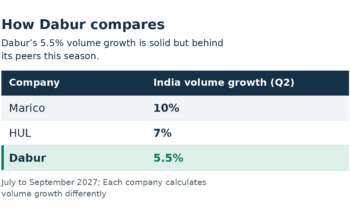
That suggests Dabur’s revenue growth relies partly on price increases and on its international business, rather than purely on selling more products at home.
What the share price had priced in
Dabur’s shares closed at ₹394.10 on Wednesday, up 3.45%, before the results were announced, helped by the broader FMCG rally. The reaction to the results will come on Thursday.
The results are steady rather than spectacular. A 20% rise in international business and a fourth quarter of double-digit profit growth support the stock. But slower volume growth than rivals, and lower advertising spending, will make investors ask whether the profit growth is sustainable.
For the new CEO, the priority will be closing the volume gap with HUL and Marico. That will probably require more spending on brands, which means advertising is likely to rise again in coming quarters, even if it means slower profit growth in the short term.
About The Author