


For most of 2026, investors relied on the AI boom to offset expensive oil and high interest rates. This month, that strategy is no longer working. With US midterm elections less than two weeks away, markets face another source of risk.
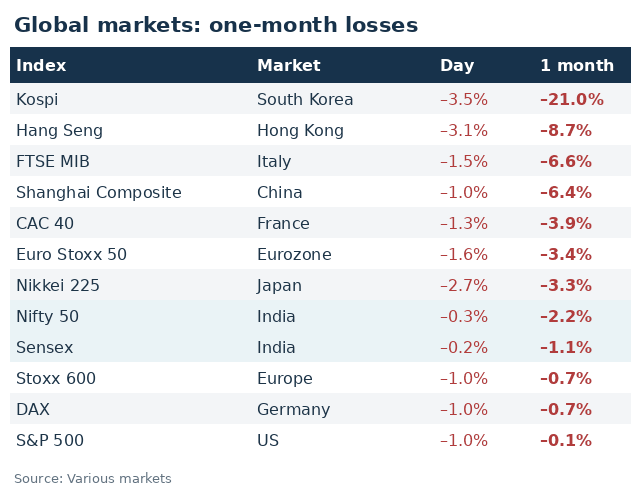
The table below shows a market under strain. The AI-driven rallies earlier in the year are reversing. Markets with little relation to AI, such as India, faced headwinds. They spent the year dealing with expensive oil and foreign selling.
The clearest signal in the table is the gap between the year-to-date column and the one-month column. South Korea’s Kospi is still up 31% for the year but has lost 21% in a month. Japan’s Nikkei is up 28% for 2026 but falling. China’s CSI 300 has dropped 10% in a month and on Thursday closed 20% below its June peak, entering a bear market. These are the markets most tied to AI hardware, and they are where the selling has been heaviest.
AI is the first pressure on markets. For two years, investors assumed that huge spending on data centres, chips and AI models would soon produce profits. This week’s early US tech earnings unsettled that view. Lam Research, which makes chip-making equipment, gave a weak outlook and fell about 7%. Tesla cut its spending plans. Meta raised its AI budget but also announced a non-voting share class. None of that is a collapse, but each result made it harder to justify current valuations. Korea and Taiwan, whose economies depend heavily on chip exports, are feeling it most. Korea’s fall is made worse by the borrowed money that fuelled its rally, with margin debt reaching about 38.6 trillion won in June.
Oil is the second. A Houthi drone strike on Saudi Aramco’s Shaybah oil field, and Washington ordering non-emergency staff out of Saudi Arabia, pushed Brent above $111 a barrel, its highest since May. Shipments through the Strait of Hormuz are still moving, but the attack showed that oil facilities themselves can be targeted. Higher oil feeds inflation and makes central banks reluctant to cut rates.
Oil also explains why Japan and India are under pressure for different reasons. Japan’s weak yen, near 157–158 to the dollar, boosted exporters’ profits and the Nikkei’s rally, but it also makes every imported barrel of oil more expensive. India imports most of its crude, and Brent above $110 adds to inflation that is already close to 6%, puts pressure on the rupee and strains government finances. That is a large part of why the Sensex and Nifty are down 13–14% this year, the weakest among major markets.
Bond markets are the third pressure. France’s 10-year yield rose above 5% for the first time since 2002 this week, renewing concerns about government debt across Europe. US 10-year yields have also risen above 5% this year. When government bonds pay that much, the case for owning riskier stocks gets weaker. It also explains why Europe’s earlier gains have stalled: the Stoxx 600 is up 8% for the year but flat over the past month.
US politics adds to the risk
US midterm elections take place on 3 November. Markets usually treat midterms as a minor event, but this year the stakes are tied to oil. Reports this week said the US and Israel could consider renewed strikes on Iran after the vote. Any escalation would put more pressure on supplies through the Strait of Hormuz and push oil higher, which is the main risk already weighing on markets.
The Federal Reserve meets on 28 October, before the vote. Traders see less than a one-in-six chance of a rate hike, so a hold is expected. With oil above $110, though, any hint that the Fed is worried about inflation would hit markets already under pressure. The Bank of Japan meets on 30 October, and the Bank of Korea held its rate at 3% this week after raising it in July and August.
China’s slide
China’s decline has domestic causes as well as global ones. Third-quarter growth of 4.5%, slightly better than expected, has reduced pressure on Beijing to add stimulus, disappointing investors who had been betting on more support. State-linked funds have been net sellers of Chinese shares this year. Weak consumer spending, a long property slump and losses in AI-linked stocks have all weighed on the market. China’s tech index has fallen more than 40% from its peak.
India in a spot
India is in an unusual position. The AI rally that lifted Korea, Japan, and Taiwan left India in the dark, a reason it underperformed this year. That also means it has little to lose as the AI trade unwinds. On the one-month view, the Sensex is down only about 1%, while Korea is down 21%.
The difficulty is that India’s main problem, oil, is getting worse. If Brent remains above $110, it could stay elevated after the US elections. This would keep pressure on inflation, the rupee, and corporate profits. Foreign investors, who have taken more than ₹3 lakh crore out of Indian shares this year, are also unlikely to increase emerging-market exposure while Asian markets are falling.
India has less to lose from an AI correction, but that does not make it a safe haven. Its outlook still depends on oil, which is now closely tied to the outcome of US politics.and a mid-term election in the US usually creates uncertainty that impact global markets.
About The Author